The Medieval Walls of Teruel
Interpretation Center of the War of the Two Peters
The Medieval Walls of Teruel
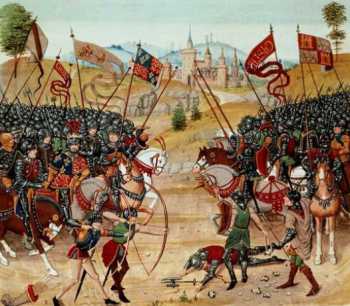
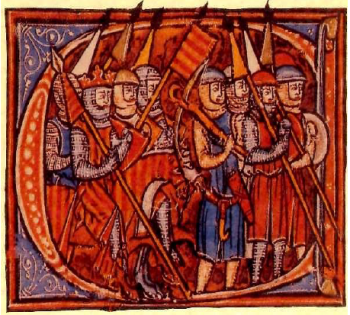
Welcome to the Interpretation Center of the Medieval Walls of Teruel and The Two Peters War, an important war that took place in XIV century between Castilla and Aragón. The name of this conflict refers to the kings that lead the battle, Peter IV of Aragon and Peter I of Castilla.
Pedro IV at 1374 wanted to perform multiple works in the city of Teruel in order to improve its defense in case of being attacked. The works were the following: the construction of three medieval cisterns that still nowadays located in the basement of Torico’s Square, to ensure the water supply in case of siege to the city, and also renovate the walled defensive perimeter to protect the city in the case of new attacks.
KNOW THE WALL:
Materials used in the construction:
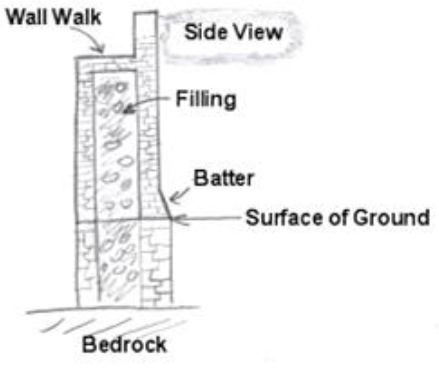
All towers and wall canvases can be dated to the second half of the 14th and 15th century. The technique employed in the construction is the masonry, obtained by the mixture of stone, brick, lime, sand and water. If we look at a cross-section of the walls, it is certified that were built using a rig consisting of two vertical walk of sillarejo or more or less regular Masonry, whose interior is filled of a thick layer of adobe drivel of varying size.
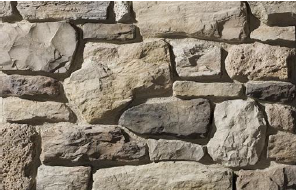
Detail of a batter wall in “sillarejo” technique
Perimeter and doors of the wall:
The wall originally presented a 1740 meters perimeter drawing an ellipse form, and had seven open gates: four of them were major gates and three secondary ones.
Among the major gates, the first and most important was Zaragoza’s Gate, with its first references in 1185; Guadalaviar’s Gate, which was in front of Turia river and dates from 1196; Valencia’s Gate dates from 1245; and finally Daroca’s Gate. The secondary gates were Saint Michael or “The Treason Gate”, the New Portal and the Shutter gate. Nowadays, only two of these seven doors still exist: Daroca’s Gate and Saint Michael’s.
Worthy of special interest is Saint Michael’s Gate and the name “The Treason Gate”, next to our Interpretation Center:
The Treason’s Gate Legend
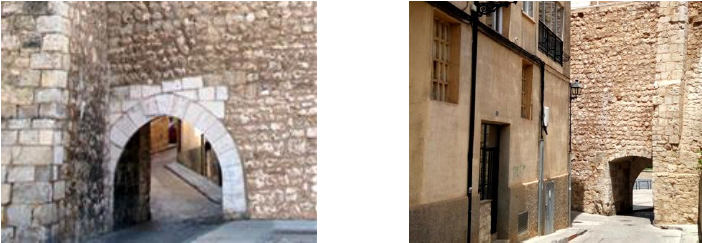
Saint Michael’s Gate is known by all the citizens of Teruel as Treason’s Gate since XIV century. In the middle of the war between Aragon and Castile (1343-1366), the city of Teruel was resisting bravely the attack of the Castilian soldiers who surrounded the walls. We were starting to run out of food and water, and the judge of the villa called Gil Torres feared the punishment from the Castilians for not easily surrender to their attack.
Fearing for his life, he made a good deal with the enemies, he will open to the Castilian army Saint Michael’s Gate, on the Day of Saint Cross, he will let the enemy in, so they took the city peacefully. The Castilians conquered Teruel and stole all its treasures, and for this treason, our king Peter IV denied us our “Fueros” (privileges by our own rules and laws). After some time, knowing the only traitor was the judge; he restored our privileges, but couldn’t apply justice to Gil Torres, who fled with the enemy.
THE TOWERS AND ITS REMAINS TOWERS OF THE CITY WALL
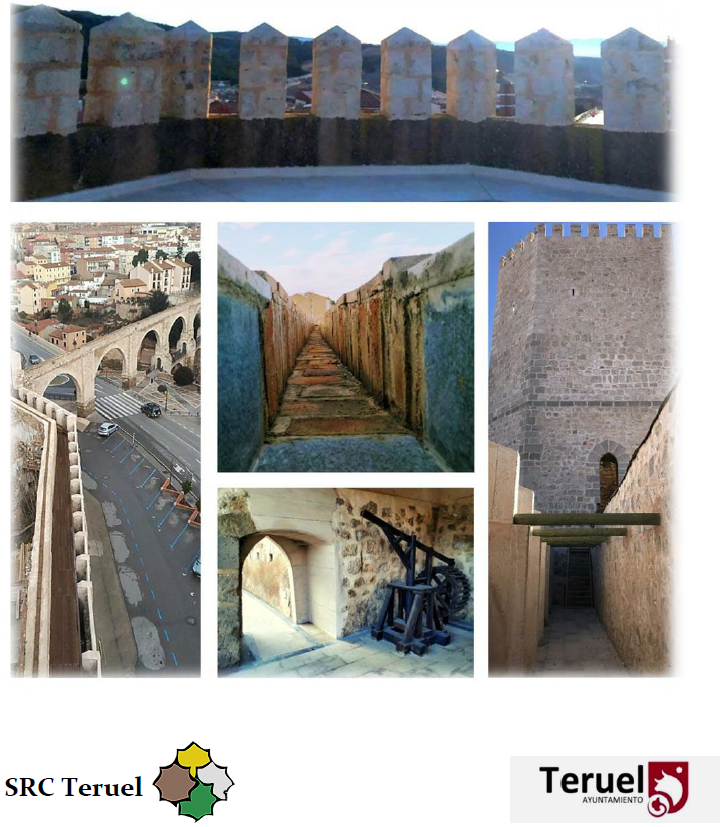
The defensive towers were located around all the perimeter of the wall. It’s possible that our walls originally presented around 30 defensive towers with diverse dating and structures. At present, only a few remain, and we can find them along Ronda Ambeles and Ronda Damaso Torán.
The most ancient tower that we preserve is Saint Esteban’s Tower, which was next to a disappeared gate. It’s an ultra-semicircular tower built by “sillarejo”, with narrow windows for the archers and crenellated top.
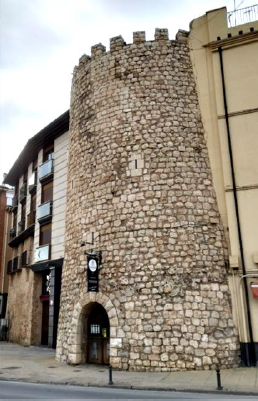
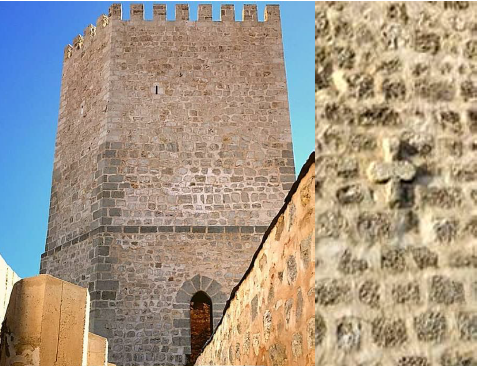
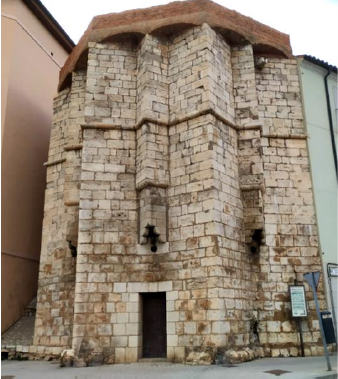
The Tower of Ambeles presents starry plant. Its constructive quality is very high although nowadays it is transformed and mutilated. It was part from the Royal Alcazar, now disappeared.
The “Lombardera” or “Bombardera” Tower, next to the “portal de San Miguel”, has chamfered corners and ends in semi-octagon, not presenting intramural wall. This constructive type belongs to XV century and the name of the tower refers to the new siege weapons from that time, the “bombarda” or “lombarda”, the cannons. On the outside walls of the tower we can see embossed cross shape stones closing the holes where these weapons were located.
Finally, the Corner Tower is associated to a stretch of wall and rectangular base, it corresponds to our Interpretation Center building. Inside, we can recognize the remains of other two towers: the Tower of Water and The Gallows’ Tower
The first one is connected to the renaissance aqueduct from the XVI century and received the water supply to distribute it around the city. This new water supply system transformed the city development and the walls, which got thicker in order to facilitate the transport of the water to the multiple fountains of the city. The Gallows’ Tower is nowadays disappeared except for the archeological remains, in which we can appreciate a cistern or store for preserving the food supply for the guards. Outside the walls of this tower were located the gallows for the executions.
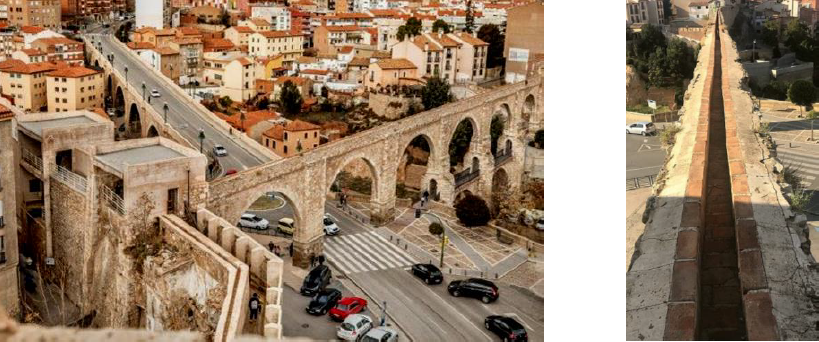
The Tower of Water and the Aqueduct “Los Arcos”
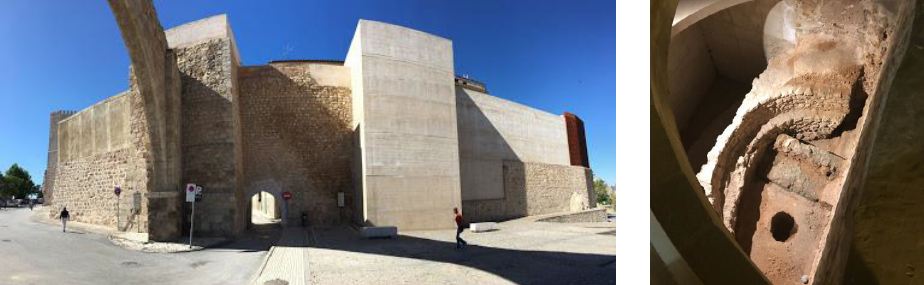
The Corner Tower (completely renovated) and the Gallows’ Tower remains
TWO PETERS WAR
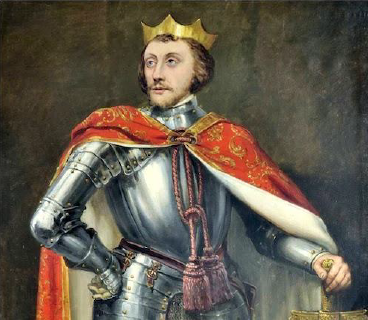
The War of the Two Peters was a conflict occurred from 1356 to 1375 between the Spanish kingdoms of Castile and Aragon. The name of the conflict refers to the rulers of these kingdoms: Peter I of Castile and Peter IV of Aragon (Pedro I el Cruel and Pedro IV el Ceremonioso).
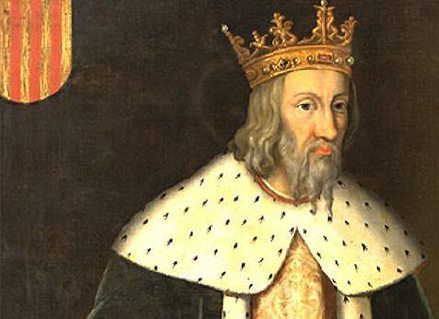
Background:
At the beginning of the XIV century, Castile was suffering from unrest caused by its civil war, which was fought between the local and allied forces of the reigning king, Peter of Castile, and his half-brother Henry of Trastámara over the right to the crown. Peter IV of Aragon supported Henry of Trastámara. Henry was also supported by the French commander Bertrand du Guesclin and his «free companies» of troops. Peter of Castile was supported by the English. The War of the Two Peters can thus be considered an extension of the wider Hundred Years’ War as well as the Castilian Civil War. Peter of Castile sought to claim the Kingdom of Valencia and Peter of Aragon wished to dominate the Mediterranean in opposition to Castile and Castile’s ally Genoa. A naval incident between the two powers had already caused tension: Catalan galleys, armed by Mossèn Francesc de Perellós, who had letters of marque from the Aragonese king, aided France against England, and also managed to capture two Genoese ships at Sanlúcar de Barrameda. Genoa was an ally of Castile. Peter of Castile, leading the Castilian fleet, caught up to Perellós at Tavira but was unable to capture him.
The War:
During the first phase of the war (1356-1361) there were military incursions by both opponents, but the main incident was the attack against the Castilian float in Barcelona’s port in 1359. Then, both monarchs searched for allies: Peter I of Castile tried to ally with the stepbrothers of Peter IV, the infants Fernando and Juan, and the aragonese allied with the Castilian nobility led by Henry of Trastámara, who were against the totalitarianism of the Castilian king. There were several peace treaties during this conflict, like the Peace of Deza-Terrer (1361), which ended up being broken and fighting again.
The second phase of the conflict took place from 1362 to 1363 and was characterized by the speed and the strength of the Castilian attacks, which led to the occupation of many villas and cities of Aragon and Valencia and the siege of its capitals. That brought great difficulties and problems for the Aragonese monarch, who had to accept the Castilian occupation of many of his lands. Peter IV responded with the death sentence of his stepbrother and allowed that his allies against the totalitarism accused Cabrera of treason and execute him (Zaragoza 1364).
The third and last phase of the war took place from 1363 to 1369, starting with the Castilian warlike superiority on its occupation of the kingdom of Valencia, but ended up with the death of Peter I of Castile in Montiel Fields (Campos de Montiel). From 1365 Henry of Trastámara came to the fore with the military forces of Aragon and led the war to Castile forcing Peter I to retreat in order to protect his kingdom. However, the accession to the throne by Henry of Trastámara didn’t bring Peter IV the advantages he expected, because the first denied to hand over the territory of Murcia and the borderlands he promised. The Aragonese king had to accept a mere compensation (Peace of Almazán, 1375), and despite the victory, the several human and material losses were extremely unfavorable to Peter IV and the kingdom.